Introduction
Afghanistan is often described as a country rich in natural resources but poor in lived economic outcomes. Estimates of vast mineral reserves—ranging from coal, gold, and precious stones to copper, iron ore, and rare earth elements—have long fueled the belief that mining could become a backbone of national development. Yet, for most Afghans, mining has not translated into improved livelihoods, employment opportunities, or public services. Instead, it has increasingly become a source of tension, local conflict, and mistrust between society and those in power.
This article argues that the core problem is not merely technical or financial, but institutional and political. Afghanistan’s mining sector is shaped by a deep conflict of interest between a highly centralized, non-accountable state and local communities who live on or near mineral-rich land but remain excluded from decision-making and revenue-sharing. The result is a growing perception that mineral wealth is appropriated through coercion and opaque deals, while ordinary people bear the social and environmental costs.
Rising Mining Revenues, Limited Social Impact
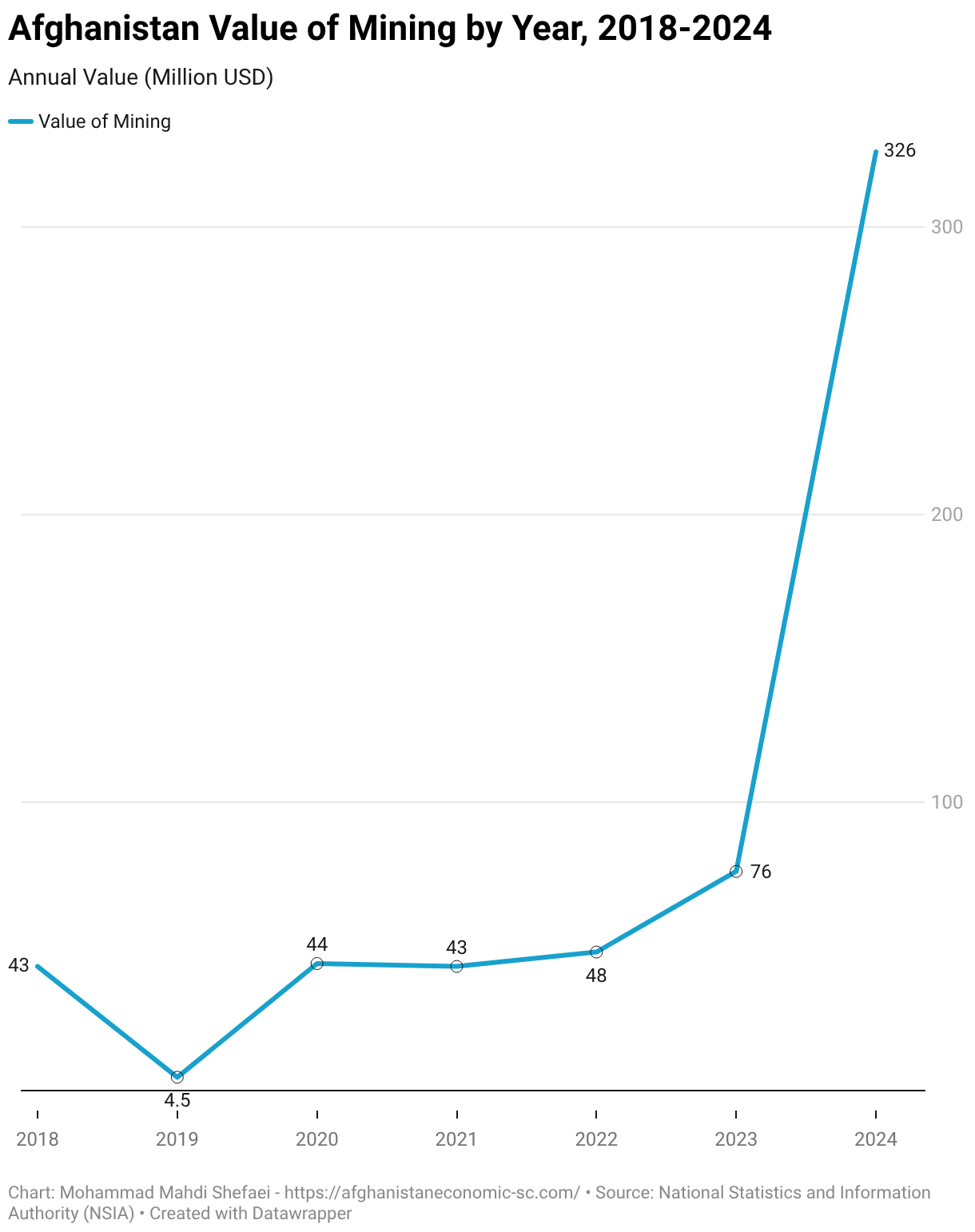
Recent data show a sharp increase in the nominal value of mining extraction in Afghanistan. As illustrated in Figure 1, the estimated annual value of mining rose from relatively modest levels between 2018 and 2022 to around 76 million USD in 2023, before jumping dramatically to approximately 326 million USD in 2024.
At first glance, this surge might suggest a positive economic trend. However, it has not been accompanied by visible improvements in employment, local infrastructure, or public welfare—particularly in remote and resource-rich provinces. For many communities, the expansion of mining activities has coincided not with opportunity, but with exclusion and heightened insecurity.
This widening gap between rising extraction values and stagnant living conditions lies at the heart of the growing conflict between the state and society.
Mining has more than quadrupled in one year, from $76 million in 2023 to $326 million in 2024.
Centralized Control and the Use of Coercive Power
Under the current Taliban-led regime, the state’s approach to mining is highly centralized. Control over mineral resources is asserted primarily through force rather than consent, legal legitimacy, or participatory governance. The regime is not the product of democratic elections; it carries no institutional obligation to ensure equitable distribution of resource revenues or to respond to public demands for transparency.
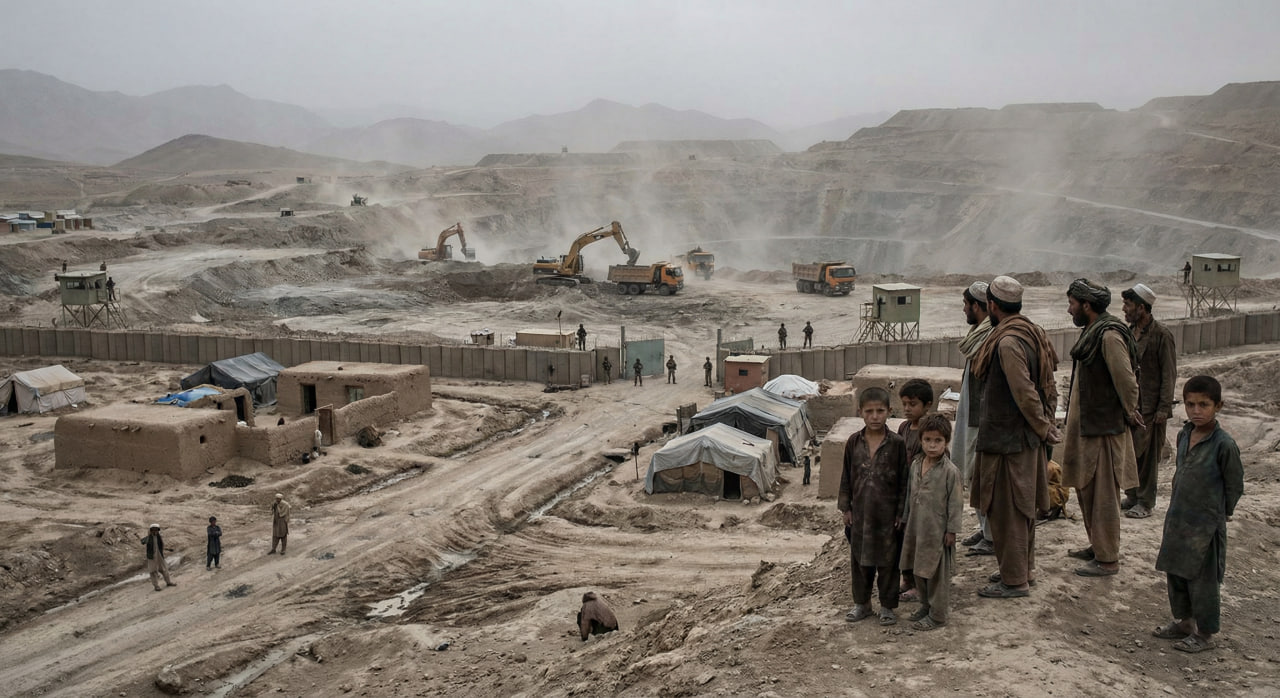
In practice, mining sites are often taken over by state authorities or affiliated actors without meaningful consultation with local populations. Communities are neither recognized as legitimate stakeholders nor granted formal rights over resources located in their areas. This exclusion reinforces the perception that mining represents appropriation rather than a pathway to national development.
The problem is particularly acute in northern provinces such as Badakhshan and Takhar, where recent clashes have occurred. In these regions, ethnic minorities already experience political marginalization. When mineral wealth is extracted from their land without participation or compensation, economic grievances merge with ethnic and political ones, intensifying resistance and social unrest.
Opaque Contracts and Foreign Companies
Another major source of tension is the growing role of foreign companies—particularly Chinese firms—in Afghanistan’s mining sector. Facing severe budget constraints and lacking domestic technical and financial capacity, the Taliban authorities have increasingly turned to external partners to develop large-scale mining projects.
These partnerships, however, are negotiated behind closed doors. Contract terms, revenue-sharing arrangements, environmental safeguards, and local employment obligations are not publicly disclosed. In the absence of accountability mechanisms, communities perceive these agreements as collusive arrangements that benefit a narrow group of power holders while transferring national wealth abroad.
This opacity deepens public alienation. Both the state and foreign companies are increasingly viewed as external actors exploiting resources that should have contributed to local and national development.
Local Communities: Excluded from the Value Chain
Despite residing in mineral-rich areas, local communities remain almost entirely excluded from the mining value chain. Most residents depend on agriculture and livestock for survival and face high levels of poverty and unemployment. Mining operations rarely provide stable jobs for local workers, and even unskilled labor opportunities remain limited.
More importantly, communities have no meaningful role in decision-making. They are not consulted on whether mining should take place, under what conditions, or how revenues should be allocated. Environmental and social costs—including water depletion, pollution, land degradation, and restrictions on traditional livelihoods—are borne locally, while benefits are centralized.
This dynamic has produced a powerful narrative among affected populations: people feel as though their land is being looted while they are forced to watch from the sidelines. Such perceptions have repeatedly translated into localized resistance and conflict.
A telling example is the case of the Dara-e-Suf coal mines, where even a Taliban-affiliated local leader, Mawlawi Mahdi, publicly emphasized the rights of local communities and opposed external control over mining contracts. His subsequent conflict with the Taliban leadership and eventual killing sent a clear signal that there is no institutional space for local bargaining or dissent within the current system.
Ethnicity, Legitimacy, and Economic Grievances
Economic exclusion in the mining sector cannot be separated from broader issues of political legitimacy and ethnic relations. The Taliban leadership is widely perceived as representing a narrow social base, largely dominated by Pashtun elites. Many minority groups, therefore, view the regime as alien and unrepresentative.
When mineral resources located in areas inhabited by ethnic minorities are extracted without local participation, the sense of injustice is amplified. What might otherwise be a dispute over revenue-sharing becomes framed as ethnic and political domination. In this context, mining functions as a catalyst for broader resistance against the state.
Weak Institutions and the Absence of a Developmental Framework
At the core of these challenges lies Afghanistan’s weak institutional framework. There is no clear legal mechanism for community participation, revenue-sharing, environmental regulation, or independent oversight. The absence of transparent and binding institutions makes sustainable resource governance impossible.
Without rules that constrain state power, mining revenues are treated as discretionary income rather than public resources. This undermines trust and prevents mineral wealth from serving as a foundation for long-term development.
International experience demonstrates that natural resources contribute to development only when embedded within strong institutions that ensure accountability, inclusion, and fair distribution. Afghanistan currently lacks these essential conditions.
Conclusion and Policy Implications
Afghanistan’s mining sector illustrates a classic resource governance failure. Rising extraction values coexist with deepening poverty, social conflict, and mistrust. The fundamental problem is not the absence of mineral wealth, but the absence of legitimate, inclusive, and transparent institutions.
Without mechanisms to involve local communities, disclose contracts, and distribute revenues fairly, mining will continue to generate conflict rather than prosperity. While the sector may provide short-term fiscal relief to the state, in the long run, it risks entrenching instability and resistance.
For mining to contribute to sustainable development, Afghanistan would need a fundamentally different approach—one that recognizes local communities as legitimate stakeholders, ensures transparency in foreign contracts, and embeds resource extraction within a broader framework of accountable governance. Until such conditions exist, the country’s mineral wealth will remain a source of division rather than a path to shared prosperity.