A Review of the 2025 UNICEF and UNESCO Reports
Introduction
Over the past several decades, Afghanistan has faced complex humanitarian crises, ranging from war and political instability to natural disasters and prolonged economic hardship. This situation has forced millions of Afghans to migrate to other countries, and the return of many of them in 2025 has placed significant pressure on Afghanistan’s education system. Nearly half of the country’s population—approximately 22.9 million people—require humanitarian assistance for survival, reflecting chronic vulnerability and the impact of acute shocks such as natural disasters and economic distress. In recent years, Afghanistan’s education system has faced widespread challenges, including inadequate infrastructure, gender-based restrictions, declining participation of girls, and pressures resulting from the return of migrants from neighboring countries.
Primary Education and Educational Quality
Despite limited progress, primary education in Afghanistan continues to face serious structural challenges. In 2024, the number of students enrolled in primary education (Grades 1 to 6) reached 6.77 million.
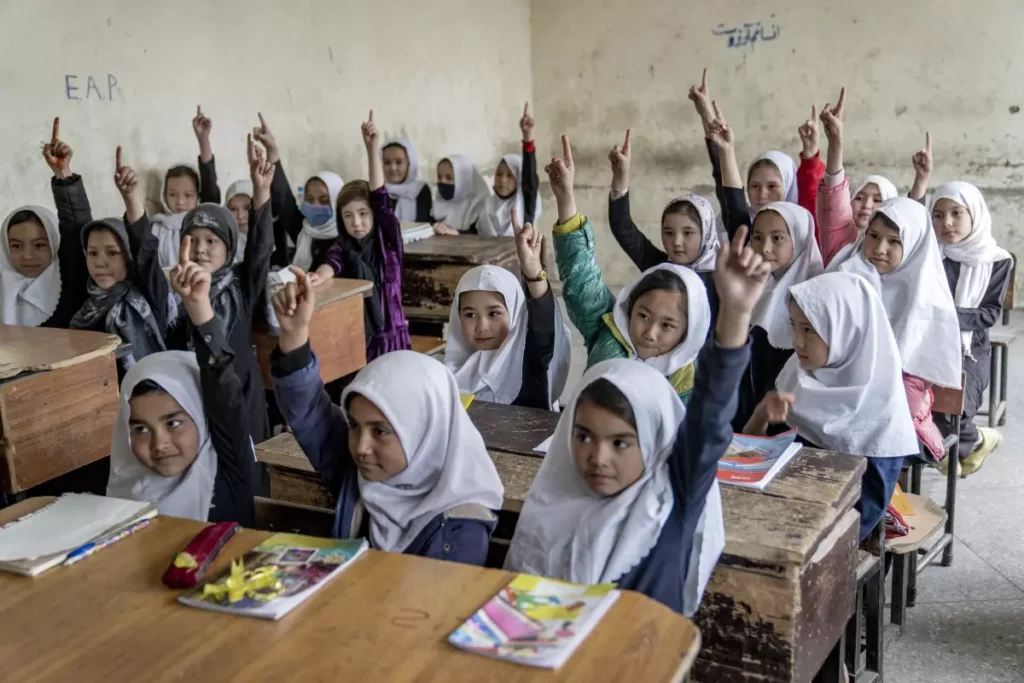
Although overall enrollment numbers remain high, the growth rate of enrollment has stalled compared to previous years. This indicates that existing school capacity has reached saturation and that economic pressures on families have increased. Rising economic hardship has forced many boys of primary school age to drop out of school and engage in hard labor or street vending to support their families. Although girls are officially allowed to attend primary school, cultural norms in some areas and the shortage of female teachers have resulted in many girls dropping out even before completing Grade 6. By 2024, more than 2.13 million primary-school-aged children remained out of school, 60 percent of whom were girls.
Nearly half of public schools lack adequate buildings, forcing children to study in tents or damaged structures. Many classrooms are overcrowded, with 60 to 80 students per class, and schools operate double or even triple shifts to meet demand. Access to electricity is limited, with 81 percent of public schools lacking electricity—a problem that is particularly severe in rural areas.
The education crisis extends beyond access and is closely linked to educational quality and learning outcomes. The quality of education is severely affected by teacher shortages and limited educational resources. As a result, 93 percent of children are unable to read and understand a simple, age-appropriate text by_toggleprimary education. Learning poverty in Afghanistan is among the highest in the world, standing 35 percent below the South Asian regional average. When 93 percent of children lack basic reading skills, this implies that over the next decade the country will produce a low-skilled labor force that is unemployed or dependent on aid, depriving Afghanistan of skilled and knowledgeable human capital and causing irreparable harm to its economy.
At the same time, the severe shortage of trained teachers—especially female teachers—insufficient learning materials, weak assessment systems, and wide infrastructure gaps have further eroded educational quality.
A UNESCO teacher competency assessment conducted in 2023, which evaluated 617 primary school teachers across five provinces, revealed that:
- Teachers’ subject knowledge in science, Dari, mathematics, and Pashto is low.
- There is a significant discrepancy between teachers’ self-assessments and classroom observations.
- Pre-service training has been insufficient in preparing teachers to address the diverse challenges of classroom teaching.
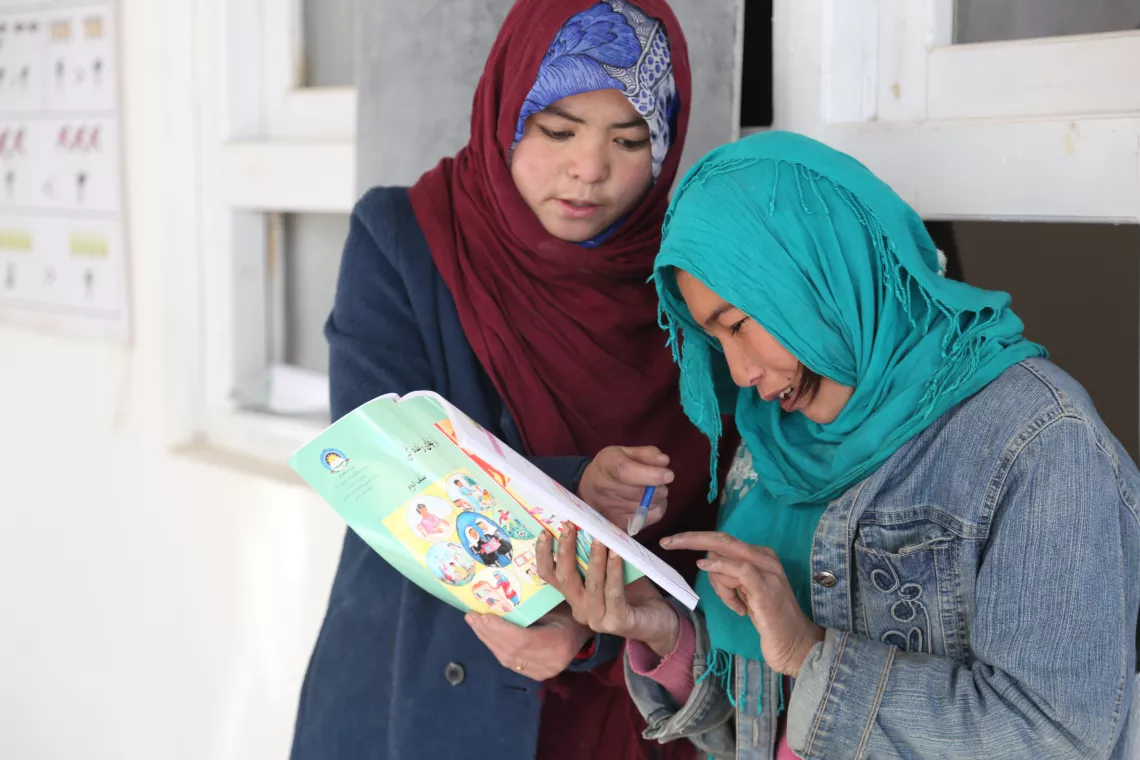
The findings indicate that the crisis in education quality is primarily rooted in weaknesses in the teacher education and training system. Teachers appear to require continuous, practical, and context-sensitive professional support.
The crisis in primary education in Afghanistan is therefore less a result of low enrollment and more the combined outcome of overcrowding, learning poverty, and a weak teacher training system.
Secondary and Technical and Vocational Education
Secondary education in Afghanistan is heavily affected by restrictions and resource shortages. Despite recent increases in boys’ enrollment, restrictions on girls’ education beyond Grade 6 have reduced their participation to virtually zero. In 2024, no girls above Grade 6 were enrolled in public secondary schools. However, official statistics continue to include girls in the system to allow for their potential return should policies change.
In the technical and vocational education sector, the number of public institutions increased from 323 in 2019 to 357 in 2024. However, this growth has not benefited female students. The number of female students declined from 14,050 in 2019 to just 716 in 2024. Similarly, the number of female teachers fell from 1,630 to 467, while the student-to-teacher ratio increased from 11 to 21. These restrictions have severely limited opportunities for women and girls to acquire technical and vocational skills.
Higher Education and Curriculum Changes
By 2024, the number of universities reached 170, yet women’s participation dropped to nearly zero. The number of female university lecturers declined from 2,599 in 2019 to 794 in 2024. Many female academics have experienced drastic income reductions, with average monthly salaries falling from around 40,000 Afghanis to less than 5,000 Afghanis.
Curriculum changes in universities and schools have also significantly affected educational quality. In 2025, several subjects and textbooks—including human rights, democracy, gender equality, and politics—were removed to align with the policies of the Ministry of Higher Education. These changes have particularly affected fields such as political science, international relations, and journalism, limiting students’ academic and career prospects. As a result, feelings of despair and hopelessness about the future have intensified among young people.
Education of Women and Girls
Since August 2021, new policies have restricted girls’ access to secondary and higher education. In 2024, approximately 2.2 million girls were denied the opportunity to continue their education beyond Grade 6. These restrictions have reduced families’ incentives to enroll girls even in primary education and increased the risk of declining participation in subsequent levels.
In the field of skills development, girls and women face even greater constraints. Mobility restrictions and bans have reduced their participation in technical and vocational training, increasing their economic and social vulnerability and heightening the risks of child labor and early marriage. Alternative programs such as home-based education and digital learning aim to fill part of this gap, although they cannot fully replace formal education. Excluding women from education is equivalent to excluding half of the country’s human capital, and this is not merely a rights issue but also a developmental and economic one.
The Impact of Migrant Returns on the Education System
The large-scale return of migrants from Pakistan and Iran has placed considerable strain on Afghanistan’s education system. By April 2025, approximately 986,000 Afghans had returned from Pakistan, and between January and August 2025, 1.7 million people returned from Iran and Pakistan combined, 39 percent of whom were children aged 6 to 18. Many of these children lack social or educational ties to the country due to prolonged residence abroad, increasing their vulnerability.
These returns have intensified infrastructure shortages, teacher deficits, and barriers to school access. Many returning children re-enter schools with limited educational backgrounds, further increasing their vulnerability and constraining their educational opportunities.
Analysis and Conclusion
The state of education in Afghanistan is complex and multi-layered. Primary education faces infrastructure shortages and a lack of qualified teachers. Secondary, technical and vocational, and higher education sectors are heavily affected by restrictive policies, leading to a sharp decline in girls’ participation. The large-scale return of migrants has further strained the education system and complicated the needs of returning children. Beyond access to education, greater attention must be paid to educational quality, which is currently in a critical and alarming condition.
The data indicate that without sustained investment, structural reforms, and inclusive programs, the education crisis will persist. Experience shows that family engagement and expanded skills-training opportunities for women and girls can help reduce vulnerability.
Lifting the ban on girls’ education beyond Grade 6 and at the university level could significantly contribute to Afghanistan’s development. Such a move could serve as a powerful catalyst for the education sector and subsequently for other economic sectors. By increasing student enrollment, employment opportunities and economic circulation would rise, while hope for the future would be restored.
Addressing this crisis requires continuous cooperation among the government, international institutions, non-governmental organizations, and local communities to preserve educational opportunities and ensure that every Afghan child—especially girls and returning children—can learn in a safe and high-quality environment. Without reopening pathways to education for girls and making serious investments in the quality of primary education, no sustainable vision for Afghanistan’s human and economic development can be imagined.