In recent weeks, two of Afghanistan’s most critical import corridors have simultaneously fallen into disruption. On one hand, tensions with Pakistan have been rising for several months, and the border has been officially closed since November. Consequently, the prices of food, medicine, and other essential goods in domestic markets have been rising as one of Afghanistan’s main traditional import routes has been disrupted. On the other hand, Iran, expected to serve as an alternative by giving Afghanistan access to maritime trade through the port of Chabahar and by easing market pressures with food and pharmaceutical supplies, has now entered an active war, ushering in a period of deep uncertainty. The escalation of conflict has not only cast doubt on Iran’s ability to serve as a substitute trade corridor to Pakistan but has also put existing commercial ties between the two countries under mounting strain.
These external shocks collide with structural weaknesses inside Afghanistan. The country’s fragile economy lacks the capacity to offset supply disruptions through increased domestic production or by rapidly establishing alternative trade routes. Limited industrial infrastructure, capital shortages, weak logistics networks, and a chronic dependence on imports have left Afghanistan with little economic room to maneuver. In the absence of strong institutions or effective policy tools, regional shocks pass quickly through the Afghan economy, often with severe consequences.
Iran: Afghanistan’s largest trade partner
Over the past decade, Iran has become one of the main pillars of Afghanistan’s external trade. According to Afghanistan’s National Statistics and Information Authority (NSIA), bilateral trade between the two countries exceeded $3.2 billion last year, placing Iran at the top of Afghanistan’s import partners.
Geography plays a decisive role: proximity, relatively low transport costs, and direct land routes allow large volumes of fuel, food, pharmaceuticals, and construction materials to reach Afghanistan through Iranian trade channels. In trade theory, lower import costs are a clear advantage; however, when a country’s supply chains become heavily dependent on a single partner, that advantage can quickly turn into a structural vulnerability, tying the importer’s economic stability to the political and economic stability of the supplier.
In times of crisis, governments naturally prioritize their domestic markets, and export restrictions often follow as states attempt to prevent shortages at home. Iran has periodically imposed such controls on food items during episodes of inflation or domestic scarcity, and the effects have consistently appeared in Afghan markets in the form of higher prices and tighter supplies. Recent announcements restricting the export of certain food products have therefore reignited concerns about Afghanistan’s dependence on Iranian supply chains. If the conflict persists and pressure on Iran’s production systems increases, these restrictions could expand in the coming weeks.
For Afghanistan, already coping with the loss of trade flows from Pakistan, any further disruption could deepen shortages and accelerate price increases in domestic markets. In a low-income economy where households spend a large share of their income on food, rising prices translate directly into reduced consumption and worsening food insecurity. Energy dependence adds another layer of vulnerability. Oil and petroleum products account for roughly 20 percent of Afghanistan’s total imports, valued at around $11.7 billion, with a large portion supplied by Iran. Iran also provides electricity to western Afghanistan, making energy flows another critical component of the economic relationship. Any disruption to these supplies would quickly raise transport and production costs across the economy, potentially triggering another round of inflation.
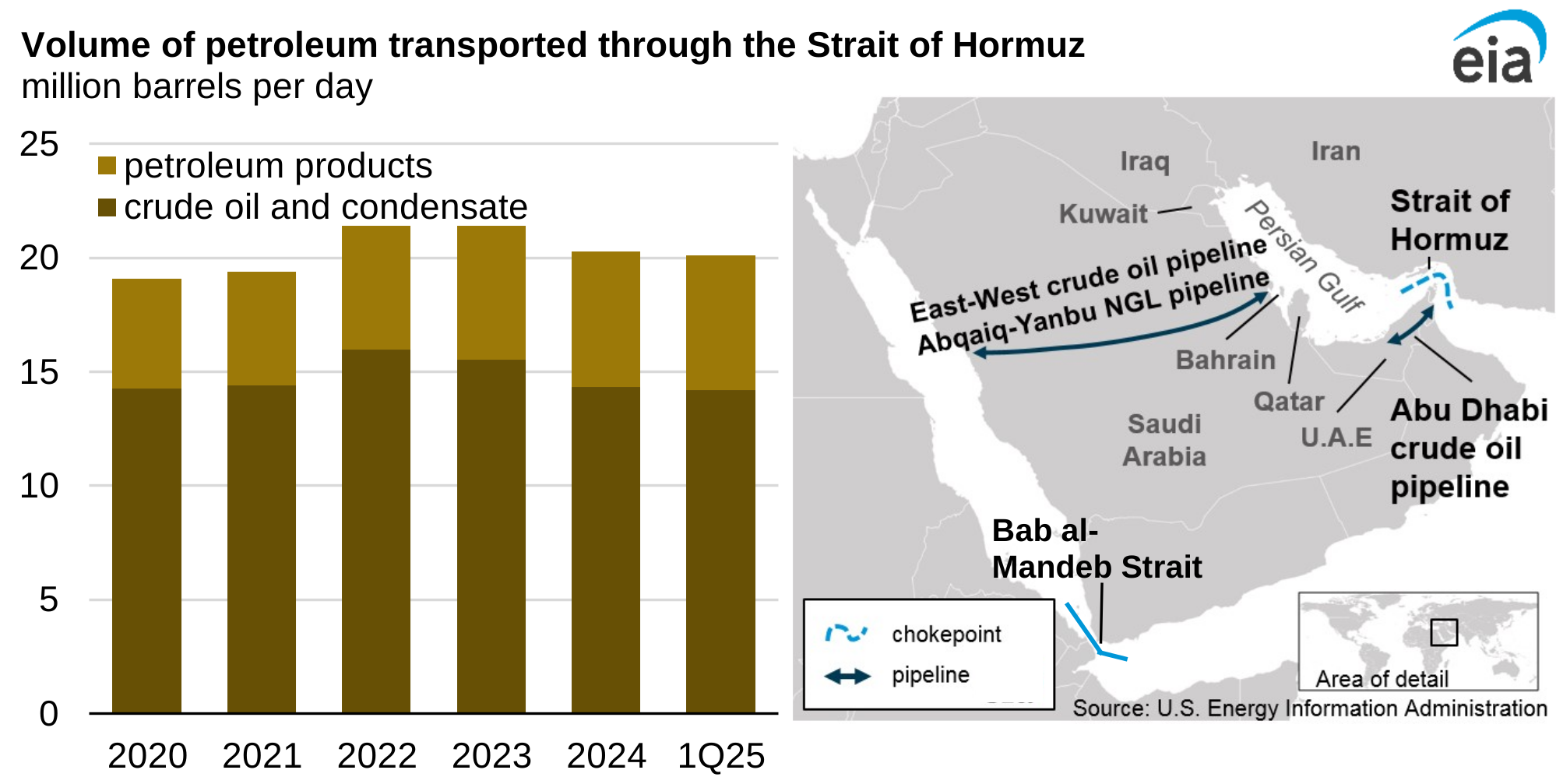
Yet the economic consequences of the conflict extend beyond bilateral trade. Escalating tensions in the Middle East and the possibility of disruptions to the Strait of Hormuz, through which roughly one‑fifth of global oil shipments pass, have already pushed oil prices to their highest level in about eighteen months. If hostilities continue, prices could rise even further.
Higher energy costs ripple through global supply chains. Production, shipping, and distribution all become more expensive. As a result, even goods imported from China, Central Asia, or the Gulf states reach Afghanistan at higher prices. In this way, regional conflict amplifies inflationary pressures across Afghanistan’s entire import structure.
Demographic shock
Iran’s economy has long grappled with high inflation, a weakening currency, and widespread economic pressures — all of which have severely affected the lives of Afghan migrants. Beyond these economic hardships, recent political instability and the security risks stemming from the ongoing war have further heightened their sense of insecurity and strengthened the incentive to return to Afghanistan.
This return is accelerating at a moment when Afghanistan is already facing a major demographic shock. According to UNHCR reports, more than 5.4 million people have returned over the past two years, an unprecedented figure. To grasp the scale of this reverse migration, one need only imagine a population roughly equal to the entire city of Kabul entering the country in a very short period of time. Such a large number of returnees, arriving in an economy suffering from deep recession and with limited productive capacity, inevitably means a sudden increase in labor supply while demand remains stagnant or even declining. The immediate outcomes are rising unemployment, falling real wages, an increase in informal work, and intensified competition for already scarce job opportunities.
The pressure of this demographic shock on public infrastructure is equally alarming. From housing to health and education services, these systems were already constrained, especially after the Taliban’s return to power, which reduced both capacity and available resources. The arrival of millions of returnees has deepened these structural gaps; In many cities, particularly Kabul, housing has become increasingly difficult, rents have risen sharply, and health and education facilities are struggling with unprecedented overcrowding. Despite these growing needs, the availability of such services has further diminished due to declining humanitarian aid. Under these conditions, each new wave of returning migrants adds additional strain on Afghanistan’s already fragile social and economic structure.
Fragile Currency Stability
In recent years, despite the large gap between imports and exports and a significant trade deficit, Afghanistan’s currency market has appeared relatively stable. Yet this stability has stemmed less from strengthened domestic economic capacity and more from imposing liquidity constraints and steady inflows of foreign exchange through external channels, particularly humanitarian aid and remittances sent by Afghan migrants abroad.
As international priorities have shifted and humanitarian assistance to Afghanistan has declined, one of these two major sources of foreign exchange has dropped steadily and might not play its previous role in supplying the economy with hard currency. This makes the second source, remittances, even more critical. However, instability, war, and economic downturns in host countries can reduce the flow of remittances, further tightening the supply of foreign currency.
At the same time, Afghanistan’s demand for foreign exchange has increased as import needs continue to rise. Limited domestic production capacity and higher consumption requirements driven in part by the return of migrants, have pushed up demand for imported goods. As a result, the economy now faces a clear imbalance in the exchange‑rate market: declining inflows of foreign currency alongside growing demand for it. This dynamic threatens to undermine the current exchange‑rate stability and could trigger a depreciation of the Afghan currency.
In an import‑dependent economy like Afghanistan, any depreciation of the exchange rate is immediately reflected in the prices of food, medicine, fuel, and other essential imported goods. So, such a shift would likely set off yet another wave of inflation.
At the intersection of crises
Afghanistan now faces multiple, overlapping shocks: border tensions with Pakistan, heavy dependence on Iranian trade, rising global energy prices, declining remittances, and a rapid influx of returning migrants. Each shock hits a different economic channel, trade, prices, currency flows, or the labor market, but together they reinforce one another in an economy with almost no shock‑absorbing capacity.
With a large share of goods imported and weak domestic production, disruptions in any major trade partner or foreign‑currency source translate quickly into higher domestic prices. This transmission is especially harsh for low‑income households, who already spend most of their income on food and have little ability to absorb new price increases. If these pressures continue, Afghanistan risks a combination of accelerating inflation, deepening poverty, and growing social instability.
These converging pressures expose a deeper structural reality: Afghanistan’s economic stability is not merely shaped by external shocks; it is fundamentally governed by them. An economy that depends overwhelmingly on imports, operates with minimal productive capacity, and relies on a narrow set of neighboring countries for both trade and foreign‑currency inflows have little agency over its own macroeconomic conditions. Instead of steering economic outcomes, Afghanistan is repeatedly forced to absorb, react to, and adjust to external disturbances originating far beyond its control.
Without a deliberate strategy to diversify production, rebuild industrial capacity, and broaden its trading relationships, Afghanistan will remain vulnerable to every geopolitical fluctuation in the region—from border disputes to energy price spikes to crises in neighboring economies. For policymakers, strengthening economic resilience is no longer a long‑term aspiration; it is an urgent necessity. Only by reducing structural dependencies can Afghanistan begin to break the persistent cycle of vulnerability that has defined its economic trajectory for decades.
War Next Door: What Price Will Afghanistan’s Economy Pay?

+ There are no comments
Add yours