By: Mohammad Eisa Rezaei
Introduction
Development is a critical global challenge. Developing Countries are striving to achieve sustainable development goals through strategic planning and targeted investments. Women, comprising half the global population, play a pivotal role in driving development. Before 1970, the role of women affected by the traditional approach of Western society was considered very low in the global production chain, thus the distance between them was very large compared to men in economic activities. The view of patriarchy and gender discrimination prevailed in women’s employment and economic relations. But with the emergence of feminist thought and women’s resistance against discrimination, this taboo was gradually broken and women were able to prove their effective presence in social and economic activities. Women’s goals were realized in fair participation with men, such as the right to equal education, political participation and benefiting from equal wages and not being completely dependent on men.
On the other hand, A nation’s human capital, rather than its physical or natural resources, is the primary determinant of its socioeconomic development. Investing in human capital through education and workforce training is fundamental for prosperity in the society. The transfer of technology and industrial advancements is facilitated by a well-educated population. Women, accounting for half of the population, have played a crucial role in driving the development of Western societies in recent decades. The Industrial Revolution in the West, by catalysing reforms in employment and Labor laws, contributed significantly to its developmental progress. Recognizing the pivotal role of women in development, the United Nations declared the 1975-1985 period as the International Decade for Women. To measure women’s progress in health, education, employment, and political participation, the UN developed the Gender Development Index (GDI) alongside the Human Development Index (HDI).
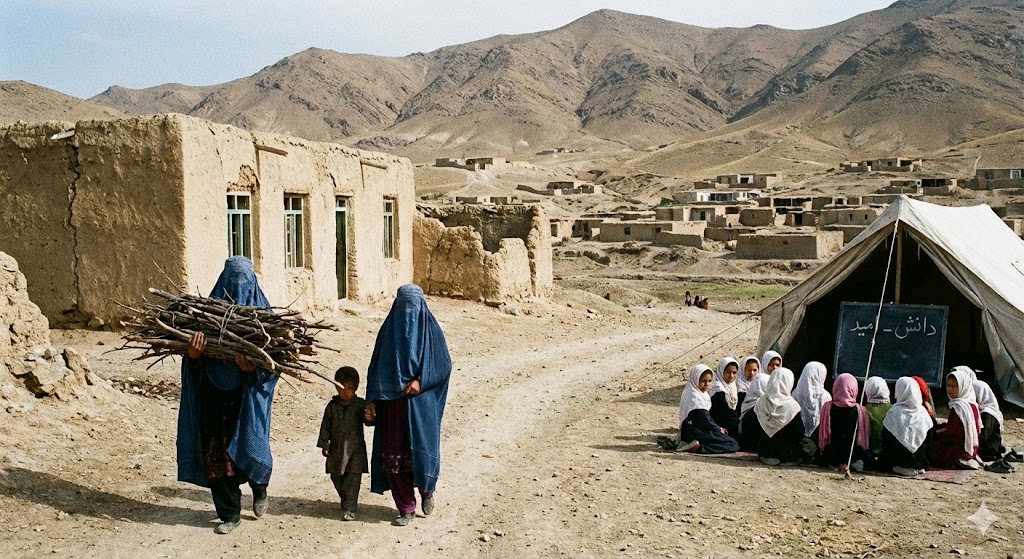
Additionally, Afghanistan, a nation plagued by decades of conflict, has faced significant challenges in achieving economic and social development. Women in Afghanistan have historically been marginalized and deprived, with traditional attitudes hindering their empowerment in economic and social spheres.
The complex interplay between tradition and modernity in Islamic countries is often misunderstood; Factors such as literacy rates and governance systems play significant roles. In Afghanistan, the lack of a modern social perspective has perpetuated a patriarchal relationship between men and women, where women are often marginalized and denied basic human rights. This gender inequality has hindered Afghanistan’s overall development and contributed to its low human development index and high gender inequality index.
This essay explores the complex relationship between women’s status and Afghanistan’s underdevelopment. By analysing the Human Development Index, Gender Development Index, and Gender Inequality Index, we can gain a deeper understanding of the challenges faced by Afghan women. Addressing these challenges is essential for Afghanistan’s progress toward a more equitable and prosperous future.
Afghanistan’s Underdevelopment
Afghanistan’s underdevelopment is often attributed to economic factors such as a lack of savings, insufficient capital accumulation, inefficient resource utilization, and inadequate infrastructure. However, the Human Development Index (HDI) reveals deeper issues, particularly the significant gender inequality in literacy rates, healthcare, and quality of life. Given that women comprise half the population, their empowerment could significantly contribute to Afghanistan’s development. Unfortunately, cultural barriers and traditional attitudes have hindered women’s ability to realize their potential.
To accurately assess Afghanistan’s underdevelopment and the status of women, the Human Development Index (HDI) and its sub-indices, along with the Gender Development Index (GDI) and the Gender Inequality Index (GII), are essential tools. The HDI, comprising literacy rate, life expectancy, and quality of life, provides a comprehensive picture. These indicators can reveal significant disparities between men and women in Afghanistan, highlighting the challenges faced by women in education, health, and economic opportunities.
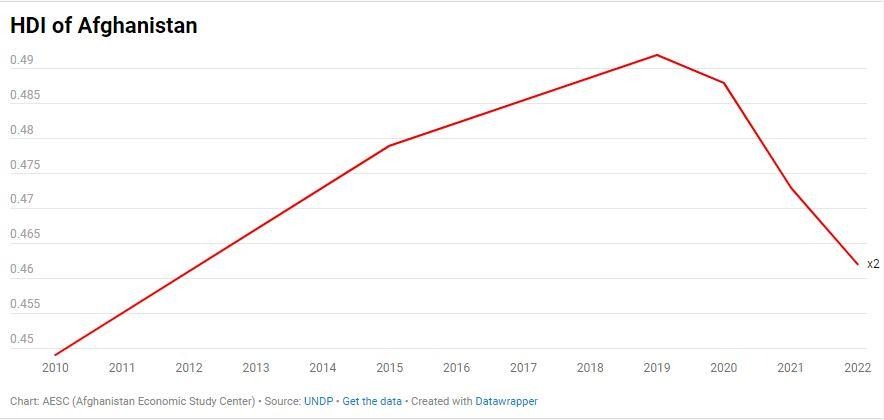
According to the United Nations Human Development Index (HDI), Afghanistan ranks among the least developed countries, currently at 182nd. While the country has made some progress in recent decades, particularly before the Taliban’s return to power in 2021, the HDI has been steadily declining since then, indicating a worsening development outlook.
Figure1: HDI of Afghanistan
The Role of Women in Afghanistan’s Development
Women are indispensable assets to any society’s human capital. While improved economic and social conditions can positively impact women’s lives, progress in Afghanistan has been insufficient. Despite relative advancements compared to the past, as evidenced by the Gender Development Index (GDI) and Human Development Index (HDI), Afghanistan’s progress remains inadequate.
Figure 2: GDI of Afghanistan
The Gender Development Index (GDI) comprises three components: life expectancy at birth, expected years of schooling, average years of schooling, and per capita income adjusted for purchasing power parity. By examining these indicators for both men and women, we can clearly see significant gender disparities in Afghanistan. The gap between men and women in the development index is particularly pronounced in education and per capita income, indicating that women are not fully benefiting from the country’s development progress.
Figure 3: Gender Development of Afghanistan
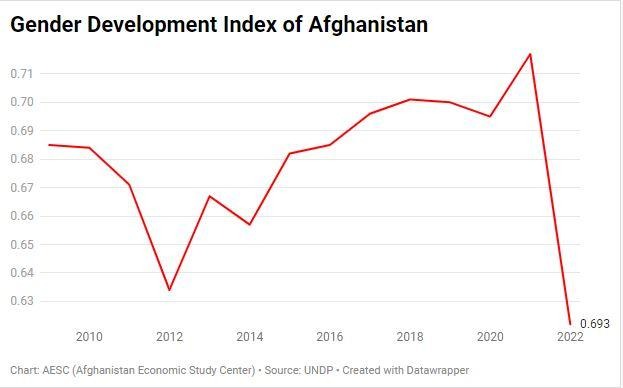
The fluctuations in the Gender Development Index (GDI) between 2008 and 2022 highlight its sensitivity to political and social changes. While the GDI experienced positive growth from 2012 to 2021, the fall of the democratic system in Afghanistan in 2021 led to a sharp decline, demonstrating the fragility of women’s progress.
Barriers to Women’s Benefit from Development in Afghanistan
Obstacles hindering women’s participation in development can be broadly categorized into two main groups: cultural, social, and economic barriers; and political and legal barriers.
- Cultural and Social Barriers to Women’s Development in Afghanistan
Traditional attitudes and stereotypes about women have hindered their participation in various social and economic spheres, often relegating them to domestic roles. Patriarchal views and religious interpretations have reinforced male dominance and limited women’s opportunities. While Islamic teachings advocate for justice and equality, extremist interpretations have justified gender discrimination. These factors, combined with widespread ignorance and illiteracy, have further marginalized women and restricted their access to education and social and economic activities. In some cases, violence and coercion have been used to prevent women from participating in public life.
- Economic and Political Obstacles to Women’s Development in Afghanistan
The theoretical understanding of women’s economic participation and its impact on development is often influenced by broader perspectives on gender. Scholars frequently examine women’s involvement in the Labor market as a key dimension of their economic participation. Research conducted in Islamic countries, including neighbouring Pakistan, has demonstrated a correlation between low economic growth and low rates of women’s Labor force participation. Given the cultural and social similarities between Pakistan and Afghanistan, it is likely that this relationship also holds true for Afghanistan.
Afghanistan’s population growth, coupled with rapid urbanization, has increased the economic burden on households. This has made it difficult for men to meet the rising costs of living, leading to reduced household services and a decline in quality of life. Women, often financially dependent, are disproportionately affected by these challenges. While the Afghan government and international aid organizations have implemented measures to support women’s economic empowerment, the high rate of unemployment among women has limited the effectiveness of these efforts. Despite constitutional provisions guaranteeing at least 27% representation for women in parliament and ministries, Afghanistan continues to suffer from significant gender inequality in political participation. According to the United Nations Gender Inequality Index (GII), the gender gap in parliamentary representation exceeds -%45.6. The Taliban’s return to power following the Doha Agreement significantly undermined the foundations of modern governance in Afghanistan. The Taliban’s patriarchal ideology led to a rapid erosion of women’s rights and their exclusion from social, economic, and political spheres. As a result, the country’s Gender Development Index (GDI) and Gender Inequality Index (GII) experienced a sharp decline.
Afghanistan’s underdevelopment is exacerbated by the underutilization of women’s expertise. Women’s contributions to the development process are crucial, as they possess valuable skills and knowledge in various fields. By excluding women from leadership roles and decision-making, Afghanistan is hindering its own progress. To achieve sustainable development, it is essential to ensure equitable access to resources and opportunities for both men and women. This will foster a more productive and efficient workforce and unleash the full potential of Afghan women in driving development.
Strategies for Promoting Gender Equality and Women’s Empowerment in Afghanistan:
Addressing the multifaceted challenges hindering women’s development in Afghanistan requires a comprehensive approach.
- To overcome cultural and social barriers, promoting modern education and fostering a more progressive mindset regarding women’s roles is essential.
- Economically, training women for the workforce, creating safe working environments, and supporting women-led businesses are crucial.
- Politically, establishing legal frameworks and promoting women’s participation in leadership positions are vital. By implementing these measures, Afghanistan can create a more inclusive and equitable society where women can fully benefit from development.